Several times a year, I open LinkedIn and see one or two posts from people boldly proclaiming that SEO is dead. They cite a pile of statistics, sometimes ones that don't relate to each other, and claim that TikTok is going to take over, or that Facebook Video is about to take off (looking at you, Gary V). Then Google releases data showing people are searching more than ever, and the conversation dies down. This has gone on for years. Ahrefs found the phrase "SEO is dead" published 3,367 times between mid-2016 and 2020 alone.
Lo and behold, in 2023 Google Bard comes knocking while the rest of us are still figuring out ChatGPT and Perplexity, and we're busy telling stakeholders that the traffic declines are "not our fault, it's AI!" Then the "SEO IS DEAD" posts start spamming our feeds, with alligator charts galore.
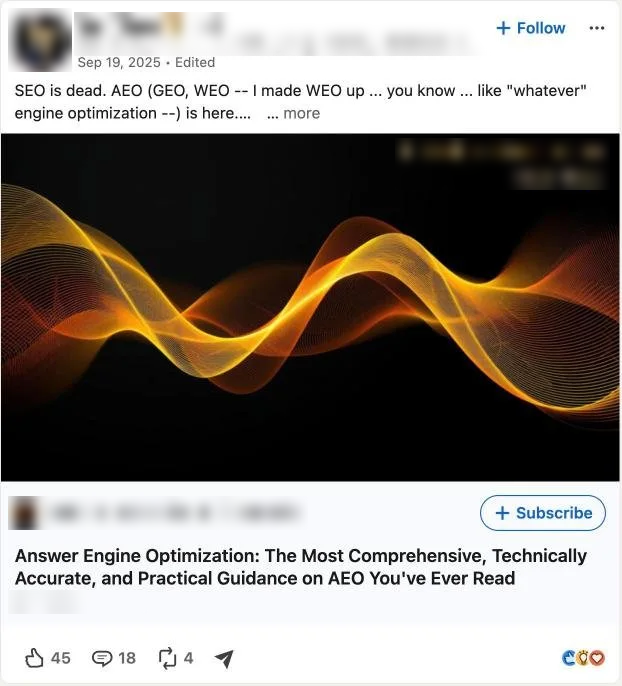
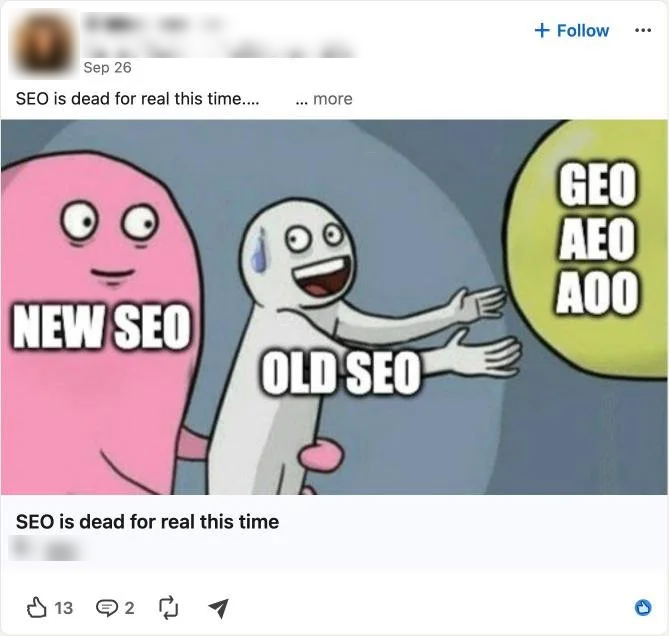
If I'm honest, I was a bit worried about job security during this time. I asked myself if I really needed to switch away from SEO. Reasonable thoughts, especially during economic uncertainty.
What's funny is that as I write this in October 2026, search marketing has never seen so much demand. I've never been this busy in my career.
We've been here before
The funeral has been scheduled a lot. In 1997, a webmaster on a mailing list called search engines a dead end. That was the same year the term "search engine optimization" caught on. In 2005, a popular blogger declared SEO dead. In 2010, a widely shared post claimed Google Instant made SEO irrelevant. Google quietly retired Instant in 2017. SEO is still here.
Panda hit almost 12% of queries in 2011 and Penguin followed in 2012. Both were supposed to be the end. What they actually wiped out was thin, copied content and link schemes. Then came mobile-first, then TikTok, now AI.
Every time, the interface changed and people still needed to find things.
- 1997Claim: A webmaster calls search engines a dead endWhat happened: The term "search engine optimization" catches on that same year
- 2005Claim: A popular blogger declares SEO deadWhat happened: Search keeps growing, year after year
- 2010Claim: "Google Instant makes SEO irrelevant"What happened: Google retires Instant in 2017
- 2011Claim: Panda and Penguin will end SEOWhat happened: Thin content and link schemes lose. Quality becomes the strategy
- 2022Claim: Gen Z picks TikTok and Instagram over GoogleWhat happened: SEO expands to video and social search
- 2023Claim: AI answers make search obsoleteWhat happened: AI search runs on retrieval from indexed pages
- 2024Claim: Gartner predicts search volume will drop 25% by 2026What happened: It's 2026. Google says queries are at an all-time high
As of now… LLMs kind of rely on it
Here's the part the "SEO is dead" crowd skips. A language model on its own only knows what it learned in training. It doesn't know what happened last week, it doesn't know your pricing, and it will confidently make things up. What it did learn in training still matters, though. Ahrefs found that branded mentions across the web correlate most strongly with how often a brand shows up in AI Overviews. What the web says about you shapes the answer before retrieval even starts.
In practice, ChatGPT, Perplexity, and Google's AI Overviews use retrieval. They take your question, run searches (Google calls it "query fan-out"), pull the best pages, and write an answer that cites them. ChatGPT uses search providers like Bing to do it. That's search. The AI sits on top of crawling, indexing, and ranking, the same plumbing SEOs have worked on for 25 years.
If your page can't be crawled, isn't clear about what it is, and has no authority, it isn't getting pulled into the answer. Sound familiar?
And for all the hype, AI tools are still a sliver of search. SparkToro found Google accounted for 73.7% of U.S. desktop search activity across 41 major search sites in late 2025, compared with 3.2% for AI tools. And 95% of ChatGPT users also use Google. The bots are growing, but most people still start at the search bar.
So what actually changed?
I'm not going to pretend nothing happened. Pew Research found that when an AI summary shows up, people click a regular result 8% of the time, compared to 15% when there isn't one. Informational queries got hit hard. If your strategy was ranking for "what is X" and monetizing the click, that got painful.
People search differently, too. Datos clickstream data shows Google desktop searches per U.S. user fell nearly 20% in 2025, even as Alphabet reports total queries at an all-time high. Both can be true. Datos measures U.S. desktop users. Alphabet counts every query, on every device, worldwide.
The rules for getting cited are shifting as well. Ahrefs' 2026 data found only about 38% of AI Overview citations come from pages ranking in the top 10, and about a third come from pages ranking beyond position 100. (Their 2025 study put the top-10 share at 76%, though the methodology changed.) For chatbots it's looser still. Across 15,000 long-tail prompts, Ahrefs found just 12% of the links ChatGPT, Gemini, and Copilot cited also ranked in Google's top 10. Ranking #1 doesn't guarantee you get mentioned anymore. But a page still has to be indexed and eligible to show in Google Search to get cited at all, according to Google's own documentation. I covered how to approach AI Overviews in an earlier post.
Clicks got harder to earn, so the clicks you do earn are worth more. Visibility now includes being the source the AI quotes, on top of the blue link. SEOs have more to do, and that's the opposite of dying.
AI sits on top of the same plumbing SEOs have worked on for 25 years.
SEO is more than just keywords
When people say SEO is dead, they usually picture someone stuffing "best plumber Chicago" into a title tag. That version of SEO started dying around 2011, and keyword stuffing is now a named violation of Google's spam policies. Nobody should miss it. It's still one of the common SEO misconceptions I run into.
Modern SEO is technical architecture, structured data, internal linking, site speed, crawl management, content strategy, and digital PR. The job is making sure machines understand who you are, what you sell, and why you're credible. An AI system needs exactly that to cite you.
I recently worked with a client that was losing ground in search. Impressions were down about a third, and ranking keywords had fallen by nearly half. When people asked AI assistants for recommendations in its space, it rarely came up.
Nothing we did was exotic. We cleaned up metadata, fixed inconsistent information about the brand across the web, and rebuilt key pages to answer the questions customers actually ask, with every statistic sourced.
Within a few months, the share of tracked AI prompts that mentioned the brand more than quadrupled, putting it ahead of its competitors. Organic sessions grew too.
Meanwhile AI Overviews landed. Impressions grew several times over while click-through rate collapsed. On a click report, that looks like a failing program. The engines were quoting us the whole time.
And most of the web still isn't doing it. Ahrefs found in 2023 that 96.55% of pages get zero traffic from Google. Search works fine. Most sites just never did the work.
The bar also went up. With AI pumping out endless generic content, the stuff that wins is original: your own data and your own experience. Rewriting what's already ranking doesn't cut it anymore. Honestly, good.
SEO jobs didn't disappear. They moved up.
Open LinkedIn and search for SEO roles. They're everywhere, and more of them now ask for AI search skills, which are mostly the skills SEOs already have.
The data shows where the demand went. Semrush analyzed 3,900 U.S. SEO job listings and found 59% were senior roles, from Lead up through Director, VP, and Head of SEO, with a median salary of $130,000. AI came up in 31% of those senior listings.
What has shrunk is the commodity work. Previsible's review of more than 10,000 SEO job listings found content SEO roles fell 28% year over year in 2024, while SEO manager listings grew 58% and VP of SEO openings grew 50%. AI can do a passable version of basic blog writing now. Demand moved toward strategy, technical SEO, analytics, and people who can explain to a CMO why their brand isn't showing up in ChatGPT.
My title went from SEO Manager to AI SEO Director. I do the same work I always did, for a lot more surfaces.
What about GEO, bro?
Oh lord. One of the biggest wastes of energy in recent memory was deciding what to call GEO. Is it AEO, AIO, AI SEO, AI search, and so on and so forth? Even more of a waste was the semi-violent discourse over the name. I don't care what we call generative search. Names are names, and they can change anytime. The goals stay the same, and so does the need to keep learning.
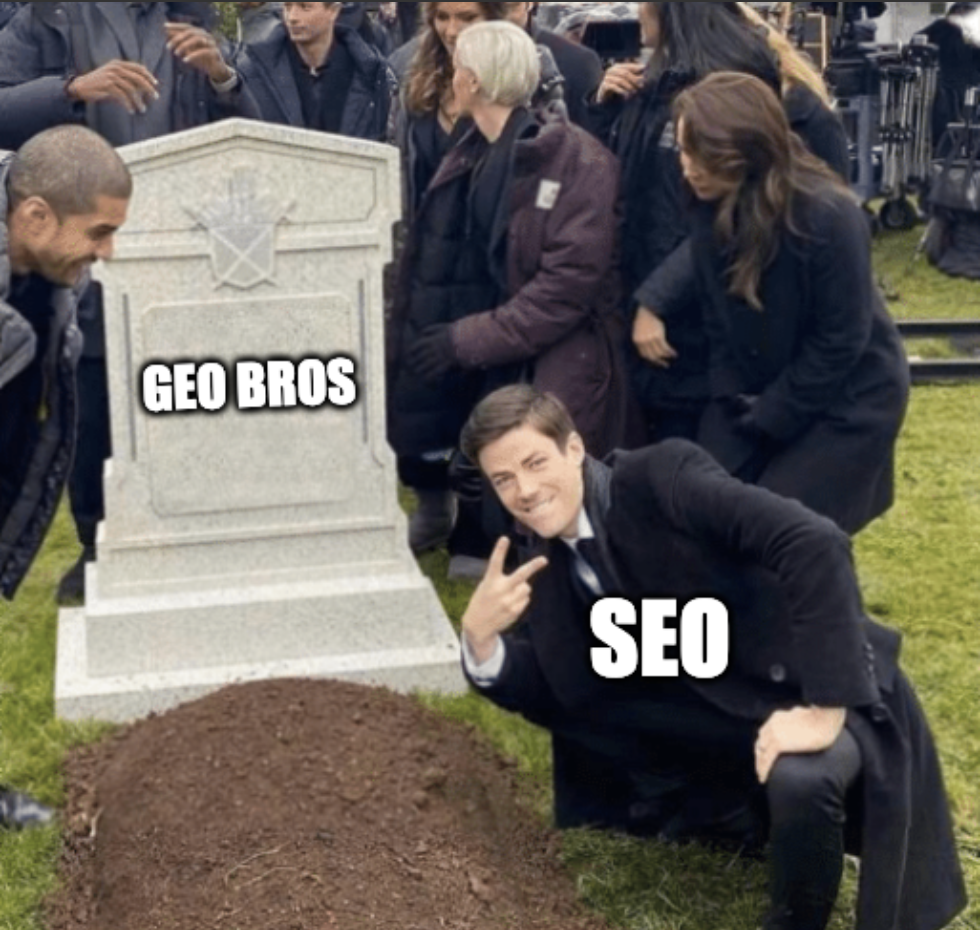
Worse were the infamous GEO bros. They had their moment in the spotlight.
The advice and tactics GEO bros sold to the public to win in AI is straight-up classic SEO. Don't take my word for it. The Princeton study that coined the term "GEO" tested tactics in a controlled 2023 experiment. The winners were adding quotes, adding statistics, writing fluently, and citing sources, which lifted visibility by roughly 27% to 41%. Keyword stuffing did worse than doing nothing. Good SEOs have been preaching that for a decade. Google calls it E-E-A-T.
Then Google published its own guide to optimizing for generative AI search. No special schema required. Google Search doesn't use llms.txt. No need to "chunk" your content. When Ahrefs tracked 1,885 pages that added schema, it found no measurable citation lift. That's Google, and the data, saying GEO is SEO.
Pour one out for the GEO bros.
Wherever there is a search bar, there will always be an SEO
People are searching in more places than ever, and every one of those places has an algorithm deciding what shows up. SparkToro found Amazon, Bing, and YouTube each still get more desktop search activity than ChatGPT. As Rand Fishkin put it, "Search is a behavior, not a channel."
More than half of U.S. online shoppers (56% in Jungle Scout's 2024 survey) start product searches on Amazon. That's search, and Amazon SEO is an entire career. YouTube is the second most visited website in the world, right behind Google. Back in 2022, a Google exec admitted that almost 40% of young people looking for a place to eat skip Google Maps and Search for TikTok or Instagram. TikTok uses captions, sounds, and hashtags to decide who sees a video. And people add "reddit" to the end of Google searches to get real opinions, something even Sundar Pichai has acknowledged.
TikTok became another place to do SEO. So did Amazon, Reddit, YouTube, the App Store, and now ChatGPT. I wrote more about how SEO and social media amplify each other.
If someone types a question into a box and an algorithm picks the answer, someone is going to optimize for it.
Will SEO actually die at some point?
I don't think so. Let's just say if email marketing still has its place in 2026, and Litmus put email ROI as high as 38 to 1 back in 2018, there's a good chance SEO will be around for a while. Email and websites survived for the same reason: they run on open standards (SMTP and HTTP) that no single company controls.
What to do instead of panicking
If your traffic dipped and someone in a meeting just said "SEO is dead," here's where I'd put the energy instead.
- Make sure AI can find you. If search engines can't crawl and index a page, AI search can't find it. Start with the technical basics.
- Publish what only you have. Quotes, statistics, and cited sources boosted visibility most in Princeton's 2023 test. Your own experience is what makes them worth citing.
- Measure citations alongside clicks. Track where your brand gets cited in AI answers alongside your organic traffic.
- Show up where your customers search. Amazon, YouTube, TikTok, Reddit. Each one has a search bar and an algorithm.
What do you do if you run into an "SEO is dead" person?
I said as much on LinkedIn last December:
Going into 2026, can we stop the "SEO is DEAD" posts? I get it. It's classic rage bait. But let's be real. If you're still claiming SEO is dead, you're either farming for likes or you don't understand what SEO has become.Brian McLeod on LinkedIn, December 5, 2025
Ten months later, the posts keep coming.
Ignore them, show some pity, and move on. There's a damn good chance their post ranks on Google anyway.
Sources (38)
- Alphabet Q1 2026 earnings call ("queries are at an all time high")
- Ahrefs, 10 SEO myths ("SEO is dead" published 3,367 times since 2016)
- seodied.com, every time SEO was declared dead, 1997 to 2026
- Techmeme, "Google Instant Makes SEO Irrelevant" (2010)
- 9to5Google, Google removes Instant search (2017)
- Google, "Finding more high-quality sites in search" (Panda, 2011)
- Google, "Another step to reward high-quality sites" (Penguin, 2012)
- OpenAI, "Why Language Models Hallucinate" (2025)
- Google Search Central, AI features and your website
- OpenAI Help Center, ChatGPT search
- Perplexity, How does Perplexity work?
- Pew Research Center, Google users are less likely to click on links when an AI summary appears (2025)
- Ahrefs, 76% of AI Overview citations pull from the top 10 (2025)
- Google Search Central, Spam policies (keyword stuffing)
- Ahrefs, 96.55% of content gets no traffic from Google (2023)
- Semrush, SEO Job Market Study (2026)
- Previsible, 2025 State of SEO Jobs Report
- Search Engine Land, Remote and content SEO roles in decline (2025)
- Aggarwal et al., "GEO: Generative Engine Optimization" (Princeton, KDD 2024)
- Google Search Central, E-A-T gets an extra E for Experience (2022)
- Practical Ecommerce, Amazon rules product discovery (Jungle Scout data)
- Similarweb, Top websites ranking
- PetaPixel, Google says young people use Instagram and TikTok to search (2022)
- TikTok Newsroom, How TikTok recommends videos #ForYou
- CNBC, Google execs on users adding Reddit to searches (2023)
- Litmus, Email marketing ROI is 38 to 1 (2018)
- IETF RFC 5321, Simple Mail Transfer Protocol
- IETF RFC 9110, HTTP Semantics
- Google Search Central, Guide to optimizing for generative AI features (2026)
- Ahrefs, AI Overview citations and top-10 rankings (2026)
- Ahrefs, AI search overlap with Google top 10
- Ahrefs, We tracked 1,885 pages adding schema (2026)
- Ahrefs, AI Overview brand visibility factors (75K brands)
- Datos and SparkToro, State of Search Q4 2025 (full report free with sign-up)
- MarTech, summary of the Datos Q4 2025 findings (2026)
- Gartner, Search engine volume will drop 25% by 2026 (2024)
- SparkToro, Search happens everywhere (2026)
- Similarweb, Is AI replacing search? (2026)